
N-ary Tree
N-ary Tree
428. Serialize and Deserialize N-ary Tree
Serialization is the process of converting a data structure or object into a sequence of bits so that it can be stored in a file or memory buffer, or transmitted across a network connection link to be reconstructed later in the same or another computer environment.
Design an algorithm to serialize and deserialize an N-ary tree. An N-ary tree is a rooted tree in which each node has no more than N children. There is no restriction on how your serialization/deserialization algorithm should work. You just need to ensure that an N-ary tree can be serialized to a string and this string can be deserialized to the original tree structure.
For example, you may serialize the following 3-ary tree
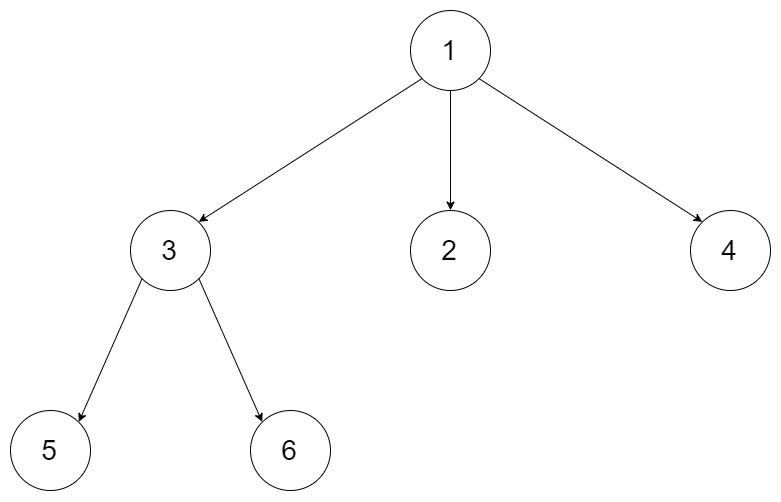
as [1 [3[5 6] 2 4]]. Note that this is just an example, you do not necessarily need to follow this format.
Or you can follow LeetCode's level order traversal serialization format, where each group of children is separated by the null value.
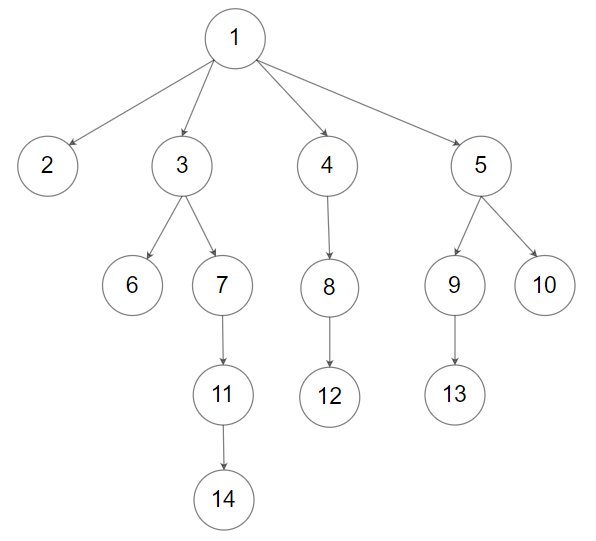
For example, the above tree may be serialized as [1,null,2,3,4,5,null,null,6,7,null,8,null,9,10,null,null,11,null,12,null,13,null,null,14].
You do not necessarily need to follow the above-suggested formats, there are many more different formats that work so please be creative and come up with different approaches yourself.
public String serialize(Node root) {
    if (root == null) {
        return "";
    }

    StringBuilder ans = new StringBuilder();
    dfs(root, ans);
    return ans.toString();
}

// 前序遍历生成的字符串
private void dfs(Node root, StringBuilder ans) {
    if (root == null) {
        return;
    }

    ans.append("[");
    ans.append(root.val);
    for (Node child : root.children) {
        dfs(child, ans);
    }
    ans.append("]");
}
// Removed global var to make Codec stateless
public Node deserialize(String data) {
if (data.length() == 0) {
return null;
}
// Use array to pass by reference
return solve(data, new int[]{0});
}
// 前序遍历
public Node solve(String data, int[] index) {
index[0]++; // Skip opening bracket '['
int num = getDigits(data, index);
Node node = new Node(num, new ArrayList<>()); // Initialize children list
while (index[0] < data.length()) {
char c = data.charAt(index[0]);
if (c == '[') {
node.children.add(solve(data, index));
} else if (c == ']') {
// 这层的节点结束
index[0]++; // Skip closing bracket ']'
return node;
}
}
// 出现异常输入有误或者确实是空节点
return node;
}
// 先序:FOR:访问
public int getDigits(String src, int[] index) {
int ret = 0;
while (index[0] < src.length() && Character.isDigit(src.charAt(index[0]))) {
ret = ret * 10 + src.charAt(index[0]) - '0';
index[0]++;
}
return ret;
}public Node deserialize(String data) {
if (data.length() == 0) {
return null;
}
// Use stack-based iterative approach instead of recursion
Deque<Node> stack = new ArrayDeque<>();
int index = 0;
while (index < data.length()) {
char c = data.charAt(index);
if (c == '[') {
index++; // skip '['
int num = 0;
while (index < data.length() && Character.isDigit(data.charAt(index))) {
num = num * 10 + data.charAt(index) - '0';
index++;
}
Node node = new Node(num, new ArrayList<>());
stack.push(node);
} else if (c == ']') {
Node node = stack.pop();
if (stack.isEmpty()) {
return node;
}
stack.peek().children.add(node);
index++;
} else { // ','
index++;
}
}
return stack.isEmpty() ? null : stack.pop();
}690. Employee Importance
You have a data structure of employee information, including the employee's unique ID, importance value, and direct subordinates' IDs.
You are given an array of employees employees where:
employees[i].idis the ID of theithemployee.employees[i].importanceis the importance value of theithemployee.employees[i].subordinatesis a list of the IDs of the direct subordinates of theithemployee.
Given an integer id that represents an employee's ID, return the total importance value of this employee and all their direct and indirect subordinates.
public int getImportance(List<Employee> employees, int id) {
    // Build a map for O(1) employee lookup
    Map<Integer, Employee> employeeMap = new HashMap<>();
    for (Employee e : employees) {
        employeeMap.put(e.id, e);
    }
    return dfs(employeeMap, id);
}

private int dfs(Map<Integer, Employee> map, int id) {
    Employee emp = map.get(id);
    int total = emp.importance;
    for (int sub : emp.subordinates) {
        total += dfs(map, sub);
    }
    return total;
}