
Shortest Path
Shortest Path
BFS 最短路
无权图
01图,每条边的权值为0或1
状态转换问题
状态转换问题的最短步骤数。图的节点表示状态,边表示状态之间的合法转换。每次转换可以视为一步,无需考虑权值。
示例问题:
- 八数码问题(求解从初始状态到目标状态的最少移动次数)。
- 字梯问题(从一个单词转换到另一个单词,每次只能变更一个字母)。
方法: 将状态看作图的节点,合法的状态转换看作边,用 BFS 搜索状态空间。
哈希表,图中存在环,同一个节点可能重复进入队列,为了避免重复入队,在入队前标记 visited
Java: HashMap / HashSet
Java 队列建议 new ArrayDeque (链表比数组慢)
无权图
Word Ladder
简单图最短路径
给出两个单词(start和end)和一个字典,找出从start到end的最短转换序列,输出最短序列的长度。
Knight Shortest Path
简单图最短路径,八个方向坐标变换
飞行棋I
从数组的最左侧跳到最右侧,只能向右跳,一步跳 1-6 格,有一些格子之间直接飞过去不耗费步数,问最少跳几步
只能向右跳->方向性 ->DP
如果没有这个信息的话,就不能DP但是可以用BFS+
问最少步数,可能是哪些算法?
A. BFS (高概率)
B. DP (次高概率)
C. DFS (几乎没有,最短路上复杂度太大不优)
D. Shortest Path Algorithm (标准最短路面试一般不考)
距离之和最短
矩阵 vs 图
图 Graph
N个点,M条边,M最大是 O(N^2) 的级别,图上BFS时间复杂度 = O(N + M)
- 说是O(M)问题也不大,因为M一般都比N大
所以最坏情况可能是 O(N^2)
矩阵 Matrix
R行C列,RC个点,RC*2 条边(每个点上下左右4条边,每条边被2个点共享)。 矩阵中BFS时间复杂度 = O(R * C)
矩阵根据题意可以是简单图也可以是复杂图,一般情况下是简单图一步一步走,那个球滚动到边界的题就是一个复杂图,每次滚动的距离不一定,且是一个隐式图
图上的例题
- 判断一个图是否是一棵树
- 搜索图中最近值为target的点
- 无向图连通块
矩阵上的例题
- 僵尸多少天吃掉所有人
- 建邮局问题 Build Post Office II
隐式图 Implicit Graph
隐式图:隐式图是仅给出初始结点、目标结点以及生成子结点的约束条件(题意隐含给出),要求按扩展规则应用于扩展结点的过程,找出其他结点,使得隐式图的足够大的一部分编程显式,直到包含目标结点为止。
抽象问题,没有明确告诉什么是点,什么是边:
状态是点、二元关系是边
矩阵是一个非常典型的隐式图,每次都按照拓展规则去找下一个访问的结点
单词接龙也是一个典型的隐式图
隐式图是仅给出初始结点、目标结点以及生成子结点的约束条件(题意隐含给出),要求按扩展规则应用于扩展结点的过程,找出其他结点,使得隐式图的足够大的一部分编程显式,直到包含目标结点为止。
推多米诺
时间模拟
按时间模拟
腐烂的橘子
可以多起点,多类目标同时模拟
eg. 逃离火灾
01图
0/1 BFS
如果某条边权值为 0,那么新拓展出的节点权值就和当前队头节点权值相同,也就自然可以作为下一次拓展的起点,所以,我们需要把它放在队头。而如果某条边的权值为 1,我们就把它正常地放在队尾。
在常规的广度优先搜索中,每个节点最多被添加进队列一次,而在 0-1 广度优先搜索中,每个节点最多被添加进双端队列两次(即队首一次,队尾一次)
在任何情况下,队列中只会含有 dis 值为 d 和 d+1 的点,且 dis 值为 d 的点一定排在值为 d+1 的点前面(这个叫 BFS 的两段性)。
- 对于边权为 0 的边 x→y,如果 dis[x]<dis[y],更新 dis[y]=dis[x],把 y 加到队首。
- 对于边权为 1 的边 x→y,如果 dis[x]+1<dis[y],更新 dis[y]=dis[x]+1,把 y 加到队尾。
问:为什么代码中没有使用 visit 数组?
答:第一个点出队后,更新邻居的 dis;等到第二个点出队时,由于邻居的 dis 已经更新过,它必不能更新邻居的 dis 值,无法产生任何影响,所以 visit 数组是多余的。
Dijkstra 算法也可以不要 visit 数组,在出堆时判断下,如果堆中存的 dis 超过了实际的 dis 值,可以直接 continue。
1197. Minimum Knight Moves
In an infinite chess board with coordinates from -infinity to +infinity, you have a knight at square [0, 0].
A knight has 8 possible moves it can make, as illustrated below. Each move is two squares in a cardinal direction, then one square in an orthogonal direction.
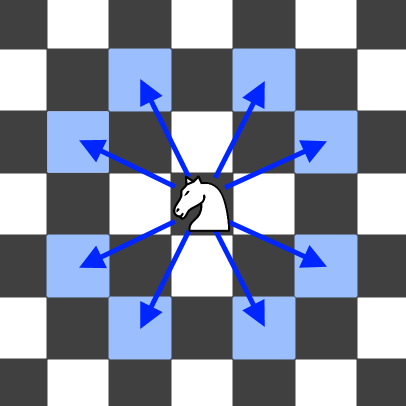
Return the minimum number of steps needed to move the knight to the square [x, y]. It is guaranteed the answer exists.
// the offsets in the eight directions
int[][] offsets = { { 1, 2 }, { 2, 1 }, { 2, -1 }, { 1, -2 },
        { -1, -2 }, { -2, -1 }, { -2, 1 }, { -1, 2 } };

public int minKnightMoves(int x, int y) {
    // - Rather than using the inefficient HashSet, we use the bitmap
    //     otherwise we would run out of time for the test cases.
    // - We create a bitmap that is sufficient to cover all the possible
    //     inputs, according to the description of the problem.
    boolean[][] visited = new boolean[607][607];

    Deque<int[]> queue = new LinkedList<>();
    queue.addLast(new int[] { 0, 0 });
    int steps = 0;

    while (queue.size() > 0) {
        int currLevelSize = queue.size();
        // iterate through the current level
        for (int i = 0; i < currLevelSize; i++) {
            int[] curr = queue.removeFirst();
            if (curr[0] == x && curr[1] == y) {
                return steps;
            }

            for (int[] offset : offsets) {
                int[] next = new int[] { curr[0] + offset[0], curr[1] + offset[1] };
                // align the coordinate to the bitmap
                if (!visited[next[0] + 302][next[1] + 302]) {
                    visited[next[0] + 302][next[1] + 302] = true;
                    queue.addLast(next);
                }
            }
        }
        steps++;
    }
    // move on to the next level
    return steps;
}
// Use record for immutable coordinate representation
private record Position(int x, int y) {}
// The offsets in the eight directions
private static final int[][] OFFSETS = {
{ 1, 2 }, { 2, 1 }, { 2, -1 }, { 1, -2 },
{ -1, -2 }, { -2, -1 }, { -2, 1 }, { -1, 2 }
};
public int minKnightMoves(int x, int y) {
// Data structures for origin BFS
Queue<Position> originQueue = new LinkedList<>();
Map<Position, Integer> originDistance = new HashMap<>();
Position origin = new Position(0, 0);
originQueue.offer(origin);
originDistance.put(origin, 0);
// Data structures for target BFS
Queue<Position> targetQueue = new LinkedList<>();
Map<Position, Integer> targetDistance = new HashMap<>();
Position target = new Position(x, y);
targetQueue.offer(target);
targetDistance.put(target, 0);
while (true) {
// Process origin level
Position currOrigin = originQueue.poll();
if (targetDistance.containsKey(currOrigin)) {
return originDistance.get(currOrigin) + targetDistance.get(currOrigin);
}
// Process target level
Position currTarget = targetQueue.poll();
if (originDistance.containsKey(currTarget)) {
return targetDistance.get(currTarget) + originDistance.get(currTarget);
}
// Expand origin frontier
for (int[] offset : OFFSETS) {
Position nextOrigin = new Position(currOrigin.x + offset[0], currOrigin.y + offset[1]);
if (!originDistance.containsKey(nextOrigin)) {
originDistance.put(nextOrigin, originDistance.get(currOrigin) + 1);
originQueue.offer(nextOrigin);
}
}
// Expand target frontier
for (int[] offset : OFFSETS) {
Position nextTarget = new Position(currTarget.x + offset[0], currTarget.y + offset[1]);
if (!targetDistance.containsKey(nextTarget)) {
targetDistance.put(nextTarget, targetDistance.get(currTarget) + 1);
targetQueue.offer(nextTarget);
}
}
}
}