
Research · Engineering · Open source
David Liu
AI Systems Researcher & Software Engineer · ByteDance
Reliable AI systems,
from research to real use.
I build tool-using agents that retrieve the right skills, validate execution, and recover from failure. My work spans research papers, open-source systems, and production infrastructure.
Along the way
Research
Research focus
Retrieve. Execute. Recover.
Agents often look capable on the happy path. I study what happens off it: skill libraries that grow into the thousands, long-horizon tool use, partial failures, and tight context budgets. Each direction pairs a paper with an open implementation.
Research signals
- 56.7%
- fewer tokens with Graph-of-SkillsSkillsBench · GPT-5.2 Codex · vs. full skill loading
- 1.1K+
- GitHub stars on Dr. ClawOpen-source AI scientist workspace I help maintain
01Retrieve
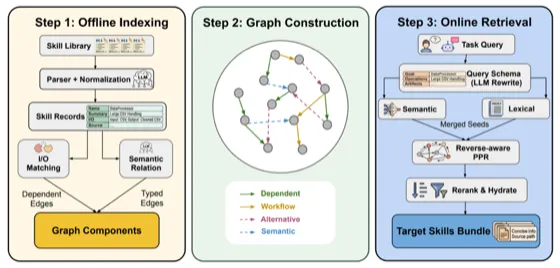
Graph-of-Skills
Retrieves a bounded bundle of skills with their prerequisites from an executable skill graph, so agents use less context without dropping what a task depends on.
View the publication: Graph-of-Skills02Execute & recover
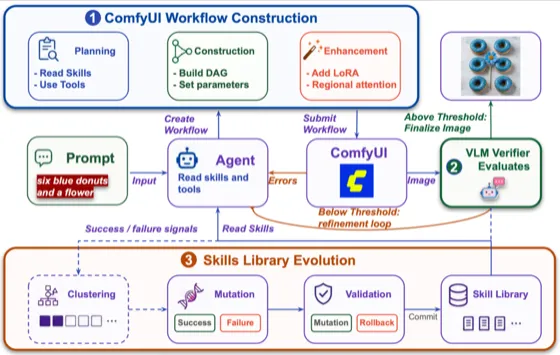
COMFYCLAW
Typed workflow edits, rollback, and visual verification let an image-generation agent detect, diagnose, and repair its own failures, then keep the fixes as reusable skills.
View the publication: COMFYCLAW03Build in the open
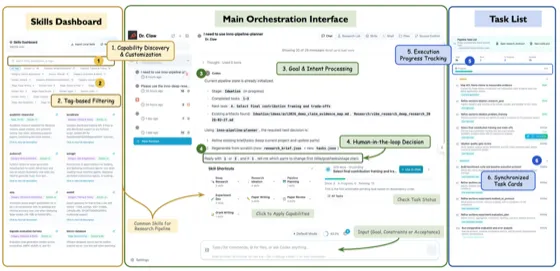
Dr. Claw
Wraps existing coding agents in an auditable, human-in-the-loop workspace, so planning, execution, and writing form one traceable, recoverable research loop.
View the publication: Dr. ClawPublications
Ordered by relevance to my current research rather than by date; the first three are the projects above. Every card has a one-click BibTeX entry.
* Equal contribution (co-first author). † Core contributor, as designated in the cited paper.
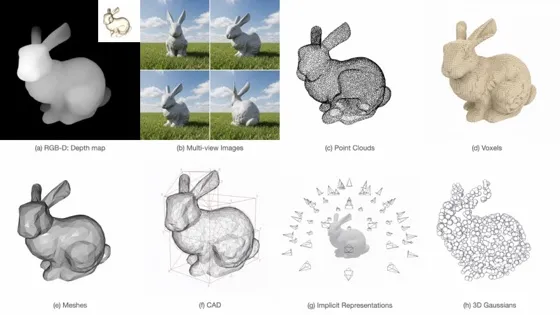
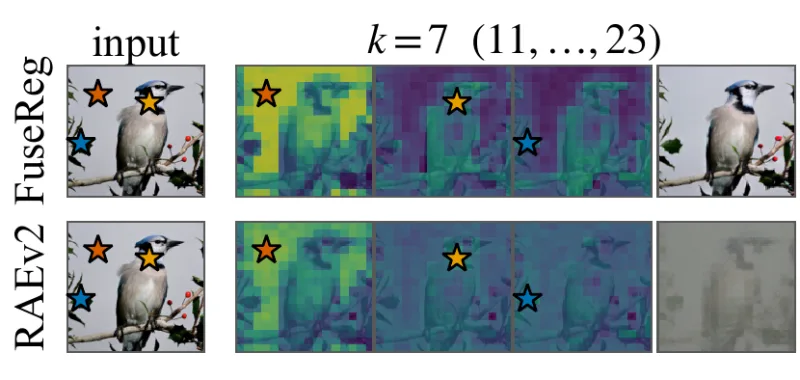
FuseReg: Regularizing Layer Fusion Mitigates the Reconstruction-Generation Gap in Representation Autoencoders
Training on random subsets of encoder layers lets one representation-autoencoder decoder reconstruct from any layer fusion; swapping in that decoder alone cuts unguided gFID by 27% on ImageNet-256.
The complete, up-to-date list is on Google Scholar and DBLP.
Open Source
Repositories that others can run and build on. Each card states my role, from first-author implementation to core maintenance.
About
I'm an AI systems researcher and software engineer at ByteDance (Commerce Ads, Seattle), and I collaborate on agent research with Prof. Lichao Sun and OpenLAIR. My work has moved from scientific visualization and distributed tracing to recommendation, agent infrastructure, and evaluation. The constant has been making complex systems useful, inspectable, and dependable.
How I work
I'm drawn to the unglamorous middle between prototype and production.
That middle is evaluation, interfaces, observability, latency budgets, failure handling, and the many small choices that determine whether software holds together. Industry work taught me to care about them; research lets me study them directly.
AI systemsAgents & retrievalExecution reliabilityEvaluation & infrastructure
Research impact & service
Updates
Selected milestones
Newest first
- ServiceAccepted an invitation to serve as a reviewer for the Synthetic & Adversarial ForEnsics (SAFE) Workshop at AAAI 2027.
- ServiceReviewing five submissions for ICLR 2027 and a manuscript for ACM Transactions on Intelligent Systems and Technology (TIST).
- PreprintThe Dr. Claw system paper, accepted to EMNLP 2026 System Demonstrations, is now on arXiv.
- PaperGraph-of-Skills accepted to the EMNLP 2026 Main Conference, after an earlier poster at the ACM CAIS 2026 Workshop AgentSkills.
- PaperCOMFYCLAW accepted to the ECCV 2026 Workshop MUCG (arXiv:2607.01709).
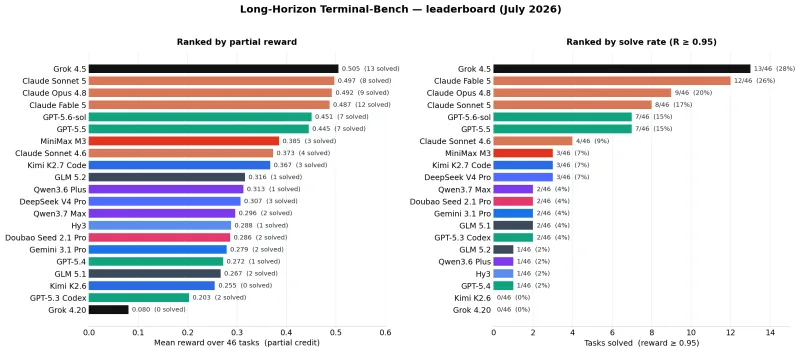
- BenchmarkContributed to Long-Horizon Terminal-Bench, a 46-task benchmark for long-running terminal agents released with the LAIR community.
Education

Graduate
University of Pennsylvania
M.S.E.Master of Science in EngineeringComputer and Information Science

Undergraduate
Northeastern University
B.E.Bachelor of EngineeringSoftware Engineering
Experience
Across four engineering roles, I have worked on advertising systems, agent infrastructure, observability, platform engineering, and backend reliability. That experience is why my research questions usually arrive with interfaces, latency budgets, and failure modes attached.
For more on the production agents in my ByteDance role, read Agent Systems in Production.

ByteDance Inc.
Software Engineer, ByteDance Inc.
Commerce Ads
Production systems for Shop Ads and AI-assisted engineering, including an evidence-grounded on-call agent, an interoperability layer for coding agents, and a resumable framework for controlled service validation.
Themes
Software EngineerJun 2026 – Present
- Architected and built a production on-call agent that triages alerts using SOPs, runtime telemetry, change history, and service-topology knowledge, pairing deterministic tools with a bounded LLM behind guardrails and an evaluation framework.
- Built a multi-protocol interoperability layer that connects an internal model platform to Claude Code-, Codex-, and Responses/Messages-compatible coding agents while preserving native tool execution, sandboxing, approval policies, multi-agent workflows, and reliable tool continuation.
- Architected a resumable, evidence-gated validation framework for online service changes with contract-defined gates, artifact and runtime checks, side-effect deduplication, auditable ledgers, and explicit human-escalation boundaries for controlled agent autonomy.
Software Engineer InternMay 2025 – Dec 2025
- Built the Image Selection system with posterior feature modeling, exploration-exploitation ranking, and multimodal LLM quality evaluation, driving 3.4%+ revenue uplift.
- Automated creative generation and enhancement for high-value products through scheduled workflows, Flink-backed asset persistence, and modular preview and diagnostics for rollout validation, contributing 12%+ revenue uplift.
- Optimized Product Handler serving reliability and tail latency through caching, asynchronous batch fetches, and offline computation, reducing p99 latency by 43.6% and cutting 80% of failure spikes during peak traffic.

Amazon
Software Development Engineer Intern, Amazon
Global-Mile Team
Distributed observability infrastructure for tracing and telemetry across microservices and serverless environments, without invasive application changes.
Themes
- Developed a Java Agent on top of OpenTelemetry and ByteBuddy for non-intrusive runtime instrumentation and payload-aware tracing.
- Implemented a loosely linked tracing module that reconstructed end-to-end call chains with business IDs across partially instrumented systems.
- Added adaptive runtime delivery for Fargate and Lambda using reflection-based environment detection with Kinesis and SQS backends.
- Built a full-stack telemetry console with query, aggregation, pagination, and multiple trace views including tree, table, timeline, and payload inspection.

JD Technology
Software Engineer Intern, JD Technology
Algorithm Tools Team
Platform engineering for internal AI tooling, with an emphasis on automation, modular system design, and cloud-native delivery workflows.
Themes
- Redesigned the Kubernetes resource-management service with ConfigMap automation, Informers, asynchronous recalculation, observer-based updates, and sharded row locking, cutting cold-start time by 20x.
- Refactored campaign page generation using a modular Strategy pattern to improve maintainability and feature reuse.
- Introduced a GenAI-assisted content pipeline to automate campaign page section creation and reduce manual operations.
- Improved CI/CD with Argo Workflows, Argo CD, and Helm-based multi-tenant deployment tooling for hybrid-cloud delivery.
Projects
Competition projects I led from concept to working product: touchless and spatial interaction on Apple platforms, and a recommendation-driven web app.
Solo Developer
Aura Chef
Winner · Apple Swift Student Challenge 2026
A touchless cooking assistant for iPad: on-device hand-pose recognition and voice commands let cooks move through a recipe without touching the screen.
- Tracked 21 hand joints with the Vision framework and a custom low-pass filter to separate intentional gestures from sensor noise.
- Designed a Dual Confirmation Ring and large-scale palm gestures for accessibility, with voice control and text-to-speech as fallback modalities.
- Built an AI Visibility Bar that monitors lighting and distance in real time, plus a hand-skeleton PIP so users can see how the model reads their intent.
SwiftUIVisionCombineSpeechAVFoundation
Team Lead · Sole Developer
Trace Note
National Final 2nd Prize · China Collegiate Computing Contest 2022
An AR social app for the Mobile Application Innovation track, co-hosted by Apple and Zhejiang University, where users anchor and share geotagged notes in physical space and earn tokens through daily check-ins.
- Also won the Northeast Division Innovation Track First Prize; I led the team and wrote all of the software.
- Optimized spatial trace retrieval with Redis Geo for real-time nearby queries and distance-based ranking.
- Used Lua scripts for atomic inventory pre-checks, preventing overselling and enforcing a one-order-per-user policy.
- Handled async order creation and timeout-based cancellation via RabbitMQ delayed message exchange.
SwiftARKitRedis GeoRabbitMQLua
Team Leader
Juejin Clone
1st Prize · ByteDance Youth Camp 2022
A developer-community web app rebuilt with a personalized “For You” feed, social interactions, and responsive design.
- Built the personalized feed with TrustSVD plus timeline signals to address cold start in recommendation.
- Automated daily data refresh and model retraining with Spring Scheduler to keep recommendations fresh.
- Implemented JWT and RBAC with Sa-Token for fine-grained access control and session management.
ReactSpringTrustSVDSa-Token
Knowledge Base
A long-running technical knowledge base, kept alongside my research and engineering work. It aims for reusable mental models rather than definitions, connecting first principles, problem-solving methods, and production tradeoffs.
01
Model · Explore · Optimize · Verify
Algorithms
Data structures, search, dynamic programming, optimization, correctness, and interview problem solving.
Open the algorithm map →02
Foundation · Model · System · Product
AI Systems
Deep learning, language models, inference, agents, recommendation, search, and evaluation.
Open the AI map →03
Runtime · Network · Design · Distributed
CS Foundations
Operating systems, computer networks, OOD, design patterns, and scalable system design.
Open the CS map →04
Build · Store · Integrate · Operate
Software Engineering
Languages, data systems, middleware, delivery, observability, testing, and production practice.
Open the engineering map →How I write these notes
Directory pages provide the map; topic pages develop one idea at a time; case studies test those ideas under realistic constraints. When a subject spans several areas, I use cross-links rather than duplicate the same explanation.
Course archive →Personal notes →TOEFL & GRE study system →All notes →
Tech Stack
Four layers I work across, from research prototypes to production services. Deeper notes live in the AI, CS, and software engineering maps.
01Models & agents
AI & Agent Systems
Model, retrieve, evaluate, and operate tool-using systems under real context, latency, and reliability constraints.
02Services
Backend & Distributed Systems
Build typed services, ranking pipelines, streaming jobs, and the interfaces that let them evolve safely.
03Data & infrastructure
Data & Infrastructure
Design storage and delivery foundations with explicit tradeoffs across scale, failure, cost, and observability.
04Product & interfaces
Product & Interfaces
Turn systems into usable research workspaces, web products, visual tools, and spatial experiences.
Résumé


Updated Oct 2026
The same story, in two pages.
Page one covers education, research and open-source work, and engineering roles; page two covers publications, research impact, honors, and skills. It is typeset from source and rebuilt with every update.