
Quiz
Quiz
Processes
What does the program output?
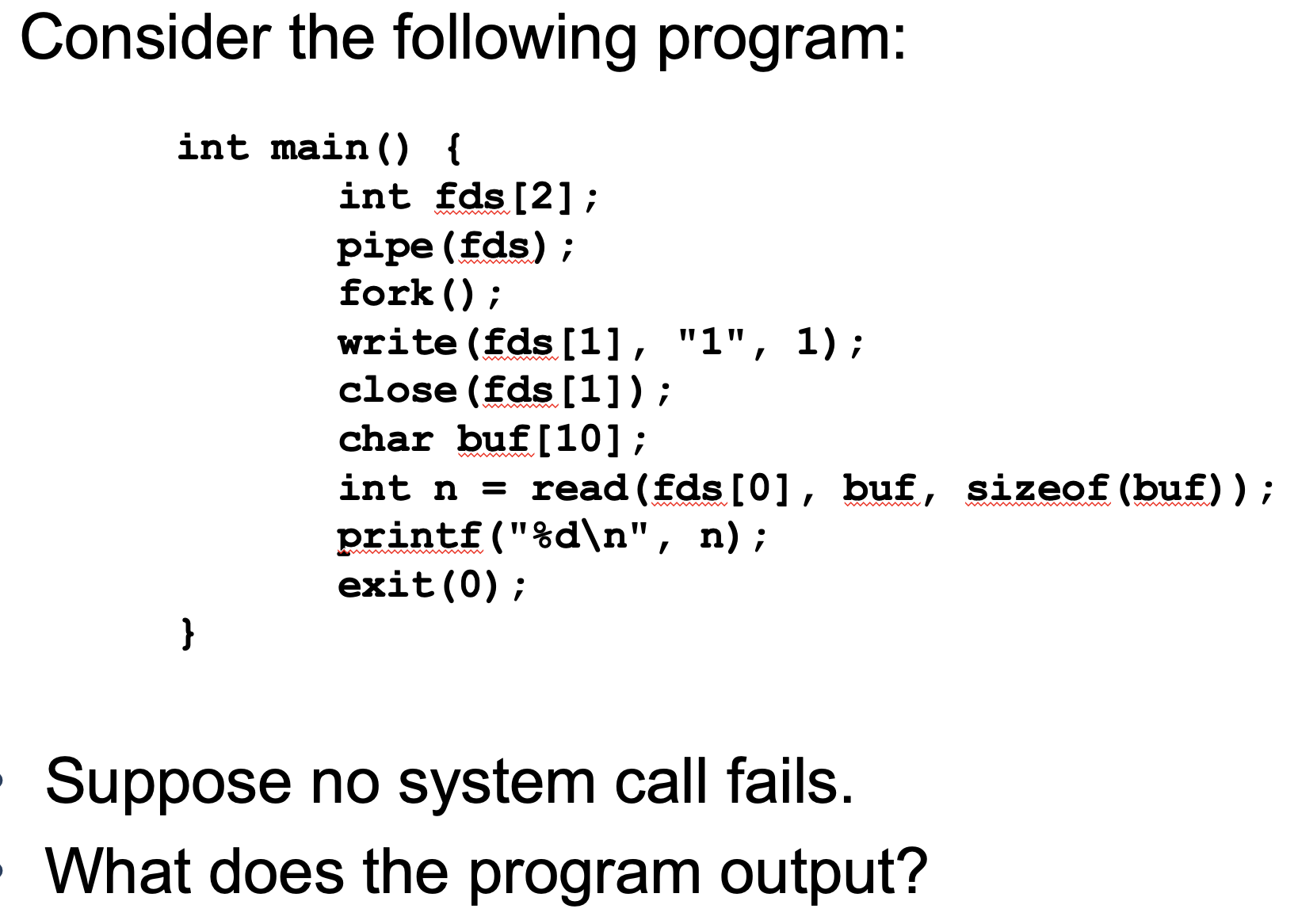
- 1 then 0, or 0 then 1
- 1 then 1, or 2 then 0
- 1 then 2, or 2 then 1
- 0 then 2, or 1 then 1
- Outputs many lines and does not terminate
情况 A:竞争读取(1 then 1)
- 父进程写入 1 字节,子进程写入 1 字节。此时管道内存有 2 字节。
- 父进程执行
read,读取了 1 字节,打印1。 - 子进程执行
read,读取了剩下的 1 字节,打印1。
- 输出:1 then 1(顺序可能相反)。
情况 B:一个进程抢先读取全部(2 then 0)
- 父进程和子进程都完成了写入。此时管道内存有 2 字节。
- 父进程(或子进程)率先执行
read。由于管道里有 2 字节,且buf大小为 10,read会一次性读完所有数据。此时n = 2,打印2。 - 另一个进程随后执行
read。此时管道已空,且由于两个进程都已经执行了close(fds[1]),管道的写端引用计数降为 0。read发现没有写端了,直接返回0(EOF)。打印0。
- 输出:2 then 0(或 0 then 2)。
Communication
Quiz 1: Which is the most likely cause?
- a) TCP stalled due to full receiver buffer
- b) Improper server-side session handling
- c) Asymmetric IP routing (different paths from/to the server)
- d) DNS naming resolution failure
解析: 这是一个非常经典的复杂网络问题。非对称路由(去程和回程路径不同)会导致防火墙状态检测失败、延迟波动或 TCP 性能下降。你的选择是准确的。
Quiz 2: Which approach to use?
- a) Force all clients to use the same CPU architecture
- b) Use TCP to ensure reliable communication
- c) Serialize multi-byte fields into network byte order before transmission and deserialize at receiver
- d) Use smaller packet sizes
解析: 非常正确。因为不同的 CPU 架构(如 x86 和 ARM)可能使用不同的字节序(大端或小端),如果不统一转换成网络字节序(Network Byte Order,通常是大端),接收方解析出的数字就会变成乱码。
Quiz 3: Which is NOT the difference between stream vs. datagram sockets?
- a) Data is sent as messages in datagram sockets, and as a stream of bytes in stream sockets
- b) Message delivery is reliable with stream sockets, but not with datagram sockets
- c) Port numbers are supported for stream sockets, but not for datagram sockets (your response)
- d) Stream sockets ensures in-order data delivery, datagram sockets do not
解析: 完全正确。**端口号(Port numbers)**是传输层(Transport Layer)的概念,无论是面向连接的 TCP(Stream)还是无连接的 UDP(Datagram),都必须使用端口号来区分不同的应用程序进程。
Which is not a layer of the OSI model?
- Session
- Presentation
- Datalink
- Logical
解析: 正确。OSI 七层模型包括:物理层、数据链路层(Datalink)、网络层、传输层、会话层(Session)、表示层(Presentation)和应用层。并没有所谓的“逻辑层”。
With little-endian encoding, which comes first?
- The lowest-order byte (your response)
- The highest-order byte
- The byte in the middle
- A random byte
解析: 正确。在 小端序(Little-endian) 中,数据的“小端”(低位字节)存储在内存的低地址端。例如,0x1234 会被存储为 34 12。
Which are best use cases for stream socket?
- Streaming live video over the Internet
- Accessing your Path@Penn
- Transferring large files
- Looking up a name in a directory
Stream Sockets 胜在“稳”和“准”,适用于:
- 文件传输 (FTP)
- 电子邮件 (SMTP/IMAP)
- 远程登录 (SSH)
- 网页浏览 (HTTP/HTTPS)
RPC
Differences between an RPC and a local function call?
- (a) RPCs require extra parameters to identify the server.
- b) RPCs typically have higher latency.
- c) RPCs can only support functions with call-by-value semantics.
- d) RPCs can fail whereas local functions do not.
- e) I don't know
为什么选 c? 在本地调用中,我们可以传递指针(Pointer)**或**引用(Reference),因为父子函数共享同一个内存地址空间。但在 RPC 中,客户端和服务器运行在不同的机器上,内存是不共享的。因此,RPC 必须将参数序列化并拷贝一份发给服务端(即 Call-by-value)。
关于其他选项:
- b) 和 d) 其实也是正确的描述(RPC 延迟更高,且可能因为网络问题失败),但在分布式系统理论中,**语义(Semantics)**上的限制(如无法传递内存指针)通常被认为是最本质的区别。
To reduce overhead, Alice's program first calls an asyn RPC to a server, then waits until the server returns a result using another asyn RPC. Does it achieve her goal?
- Yes
- No
- Unsure
Select the correct reason and fix.
- Memory leaks due to retries; clearing memory.
- Thread exhaustion; reject new retry requests
- Head of line blocking; increase worker pool size
- Deadlock; use semaphore
Alice 的设计实际上引入了经典的 “双重等待” 或 “回调地狱” 问题。
- 资源开销: 即使使用了异步调用,如果 Alice 的程序在“等待服务器返回结果”期间仍然占用着某些关键资源(如线程池中的 Worker Thread 或网络连接),当请求量增大时,会导致线程耗尽(Thread Exhaustion)。
- 重试机制的副作用: 在分布式环境中,如果 RPC 超时触发了自动重试,而原本的请求其实还在处理中,系统就会堆积大量重复请求,进一步恶化线程耗尽的情况。
- 修复建议: 应该引入**拒绝服务(Backpressure)机制,或者改用真正的事件驱动(Event-driven)**架构(例如使用
Promises或Futures),确保在等待期间不阻塞工作线程。
Naming
Select all correct statements
In asynchronous systems, flooding guarantees a request will reach all nodes in the network if there is no network partition
- 只要网络没有分区(Partition),洪泛算法(Flooding)最终会覆盖所有连通的节点。
In iterative DNS naming resolution, the root servers retain no state of the client requests
- 迭代查询中,根服务器只负责返回下一级服务器的地址,它是无状态的。
Anycast DNS guarantees globally consistent answers
DNSSEC can defend against DDoS attacks
In P2P network, a new node can join the system without knowledge of an existing node in the network
DNSSEC provides authenticity but not confidentiality.
- 它使用数字签名保证数据没被篡改(真实性),但并不对查询内容加密(非机密性)。
In Akamai, small TTL is used to improve latency
Clock synchronization
NTP Review: How to fix the offset spike?
- Synchronize more frequently
- Increase response timeout
- Use NTP multicast to reduce overhead
- Use NTP manycast to find a closer server
解析: NTP 的漂移(Drift)是随时间累积的。如果同步频率太低,两次校准之间的偏移量(Offset)会变得很大。通过增加同步频率,可以使时钟时刻保持在较小的误差范围内,从而平滑 Offset 的突跳。
In a distributed system that assigns Lamport clock L(e) and Vector clock V(e) to events. Select all true statements.
If L(a) < L(b), then a --> b
- 这是 Lamport 时钟最经典的陷阱。Lamport 时钟满足 ,但反向不成立。如果 ,它们可能具有因果关系,也可能是并发(Concurrent)的。
If V(a) < V(b), then a --> b
- 向量时钟(Vector Clock)的强大之处就在于它是充分必要条件。 意味着 确实在因果上先于 。
If L(a) < L(b), then V(a) < V(b)
- “不可比”意味着事件是**并发(Concurrent)**的。在分布式系统中,并发意味着它们之间没有因果关系,并不代表它们在物理时钟上的时刻完全相同。
If V(a) and V(b) are incomparable, events a and b are guaranteed to take place at the same physical time
- “不可比”意味着事件是**并发(Concurrent)**的。在分布式系统中,并发意味着它们之间没有因果关系,并不代表它们在物理时钟上的时刻完全相同。
If V(a) < V(b), then a occurs before b in real time
Logical clocks track ordering among events whereas physical clock tracks physical time
- 这是两者的定义区别。
It is always strictly better to use Vector clock than Lamport clock because Vector clock captures causality whereas Lamport clock does not
- 并不总是“更好”。向量时钟的存储和传输开销是 ( 是节点数),而 Lamport 时钟只需一个整数。在不需要追踪精确因果关系的场景下,Lamport 更高效。
Group communication
Select all correct statements
Total ordering implies FIFO ordering but not causal
- 全序(Total Ordering)只保证所有接收者以相同的顺序接收消息,但这个顺序不一定符合发送者的发送顺序(FIFO)或因果顺序(Causal)。
FIFO ordering implies causal ordering
- 两个不同发送者发送的消息可能具有因果关系,但 FIFO 只能保证同一个发送者的消息顺序。
Causal ordering implies FIFO ordering
- 因果序是 FIFO 的超集。如果 发生在 之前(同一个人发送),那么 ,因果序必须保证 在 之前交付。
If a sender multicasts m1 before m2, total ordering guarantees m1 is delivered before m2
- 理由同第一条。全序可能让所有人都先收到 再收到 (只要大家都一致就行)。