
Scalability
Scalability
- Parallelization
- Consistency
- Mutual exclusion; locking; deadlocks
- NUMA and Shared-Nothing
- Frontend-backend, Sharding
Scalability and Parallelization
Amdahl's law
not all parts of the algorithm can be parallelized
4
2
2/3 can be parrallezed, how many CPU to be 2 times fast?
4
Is more parallelism always better?
Granularity
How big a task should we assign to each core?
- Coarse-grain vs. fine-grain parallelism
Frequent coordination creates overhead
Dependencies
Consistency
Race condition
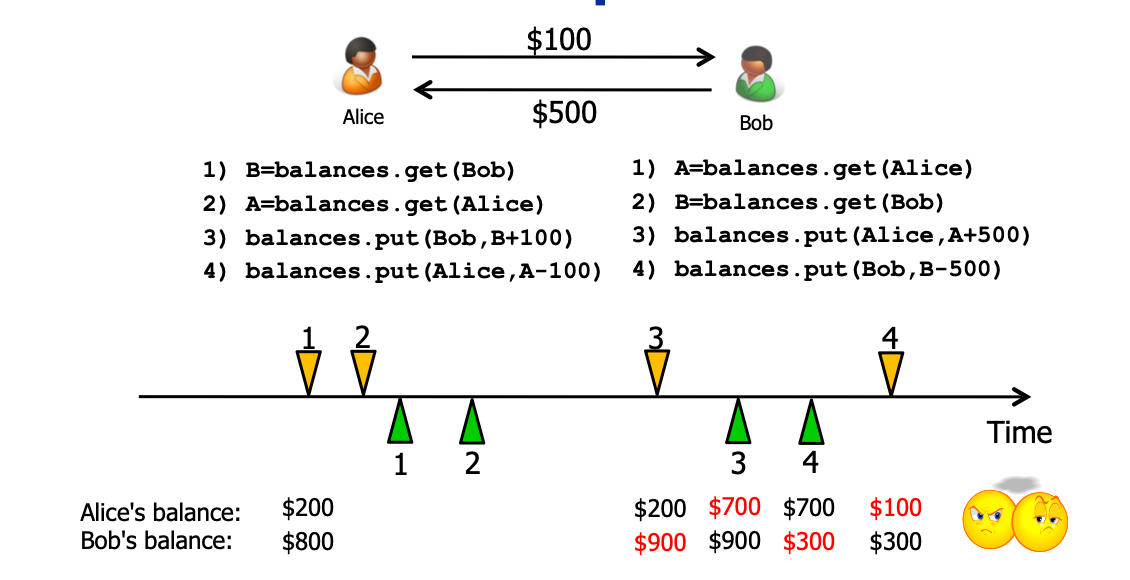
Result of the computation depends on the exact timing of the two threads of execution, i.e., the order in which the instructions are executed by the cores
Reason: Concurrent updates to the same state!
Can you get a race condition when all the threads are reading data, and none are updating it?
NO. Race conditions are caused by "concurrent updates to the same state"
Consistency
Intuition: It shouldn't make a difference whether the requests are executed concurrently or not
Sequential consistency
The strictest model
The result of any execution is the same as if the operations of all the cores had been executed in some sequential order, and the operations of each individual processor appear in this sequence in the order specified by the program
Strong consistency
After update completes, all subsequent accesses will return the updated value
Weak consistency
After update completes, accesses do not necessarily return the updated value; some condition must be satisfied first
Example: Update needs to reach all the replicas of the object
Eventual consistency
Specific form of weak consistency: If no more updates are made to an object, then eventually all reads will return the latest value
- Variants: Causal consistency, read-your-writes, monotonic writes, ...
Mutual exclusion
Locking
The Dining Philosophers problem
Deadlock
Alternatives to locks
"Optimistic" concurrency control
■ Allow accounts to be updated concurrently
■ Try to "merge" the effects (e.g., reconcile the accounts)
■ If not possible, do things in sequence
Shared-Nothing model
Symmetric Multiprocessing
Non-Uniform Memory Architecture (NUMA)
Frontend vs. Backend
Is more scalability always better?
Has cost
Run several scalable data processing systems on some large data sets