
Internet Basics
| 目的地关系 | 通告内容 |
|---|---|
| 通告给客户 (To Customer) | 所有前缀 (Self + Customers + Peers + Providers) |
| 通告给对等体 (To Peer) | Self + Customers |
| 通告给供应商 (To Provider) | Self + Customers |
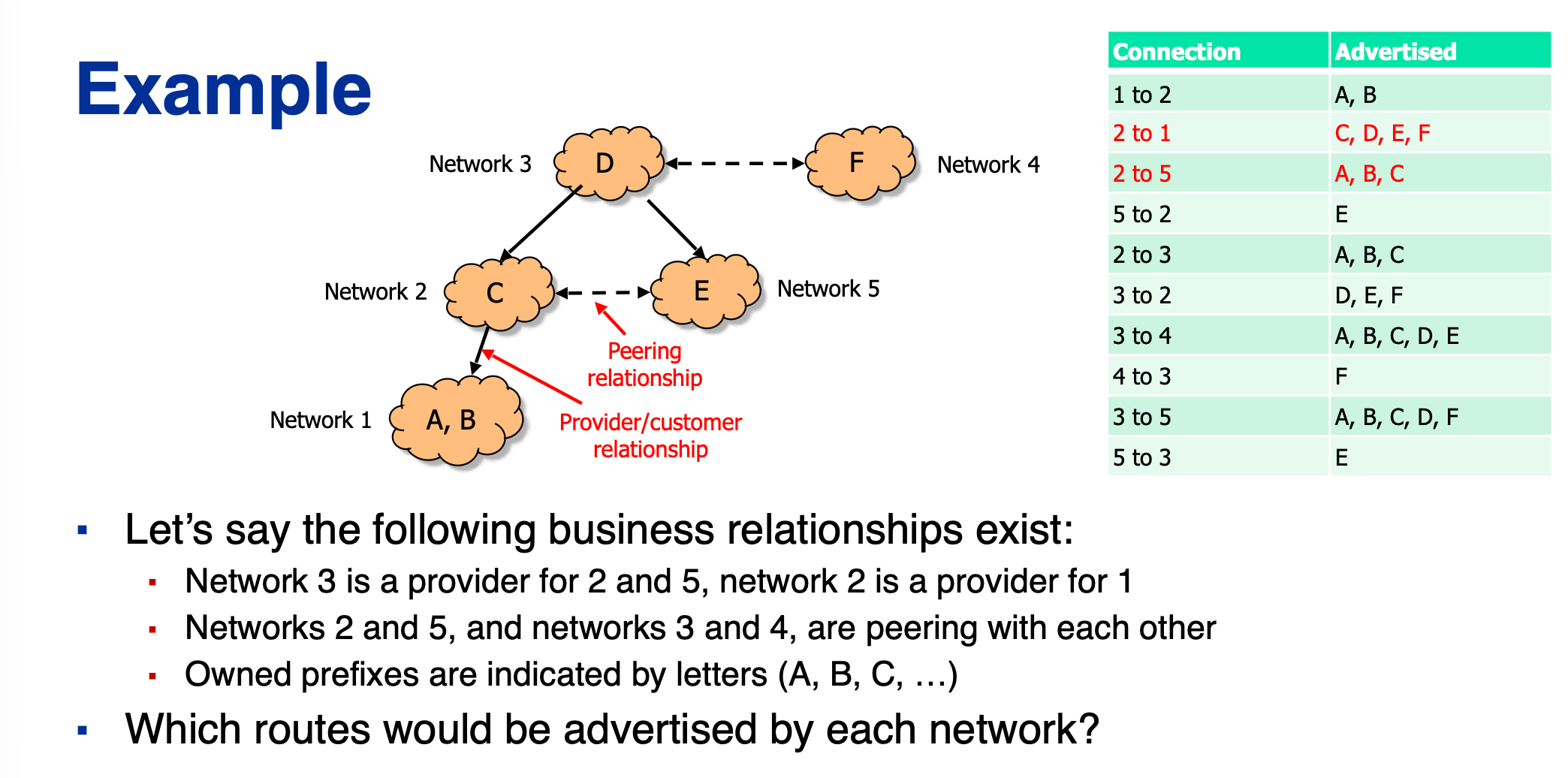
- Consider Network 3 and its customer, Network 2. Which path (s) does Network 2 announce to Network 3?
- A, B, C
- 通告给 Provider(供应商) 时,AS 必须通告 自己拥有的前缀 以及 从客户处学到的前缀。
- Network 2 自己拥有前缀 C。
- Network 2 从其客户 Network 1 处学到了 A, B。
- 因此,它会将 A, B, C 全部告诉 Network 3。
- Consider Network l and its provider, Network 2.Which path (s) does Network 2 announce to Network1!
- C,D,E,F
- 通告给 Customer(客户) 时,AS 会通告 它知道的所有最优路径(包括来自供应商、对等体和其他客户的路径)。
- C 是自己拥有的。
- D 来自供应商 Net 3。
- E 来自对等体 Net 5。
- F 来自供应商 Net 3(Net 3 从其对等体 Net 4 处学到并传给客户 Net 2)。
- Consider Network 5 and its peer, Network 2. Which path (s) does Network 5 announce to Network 2?
- E
- 通告给 Peer(对等体) 时,只通告 自己拥有的前缀 和 从客户处学到的前缀。
- Network 5 自己拥有 E。
- Network 5 在这个拓扑中没有客户(Net 3 是它的供应商),因此只通告 E。
- Consider Network 3 and its custom r, Network 2. Which path (s) does Network 3 announce to Network 2?
- D,E,F
- 同样遵循“通告给客户 = 告知一切”的逻辑。
- D 是自己拥有的。
- F 来自对等体 Net 4。
- E 来自其另一个客户 Net 5。
- (注:Net 3 通常不会把从 Net 2 学到的 A, B 再传回给 Net 2,因为这会造成路由环路或冗余)。
Scalability
2/3 of an algorithm can be parallelized, and, with N CPUs, you can get a speedup of N for that part. How many CPUs do you need to speed up the overall algorithm by a factor of 2?
4 CPUS
75% of an algorithm can be parallelized, and the maximum speedup for this part is unlimited (assuming you have enough CPUs) . What is the highest speedup for the overall algorithm you can possibly achieve with parallelization?
4x
60% of an algorithm can be parallelized, and the maximum speedup for the parallelizable part is 6x. What is the maximum speedup for the entire algorithm?
2
可并行部分 ,串行部分 。并行部分的加速比 。
公式:
DNS
Which of the following is not a real DNS record?
- CNAME
- AAAA
- HTTP
- MX (your response)
How many servers are handling requests for the root zone on the Internet today?
1
13
27
Much more than 27
What kind of namespace does DNS have?
- Flat
- Hierarchical (your response)
- Two-level (domain+subdomain)
- Attribute-based
Which machine(s) always know the mapping from a domain foo.com to the corresponding IPv4 address?
- The local client
- The name server for bar.com
- The authoritative name server for foo.com (your response)
- The client's local DNS server
- The root name servers
GFS
True or false? All the data that is read from or written to GFS must pass through the master
You can respond once
False
metadata go to master, not all data