
Intersection
Intersection
160. Intersection of Two Linked Lists
Given the heads of two singly linked-lists headA and headB, return the node at which the two lists intersect. If the two linked lists have no intersection at all, return null.
For example, the following two linked lists begin to intersect at node c1:
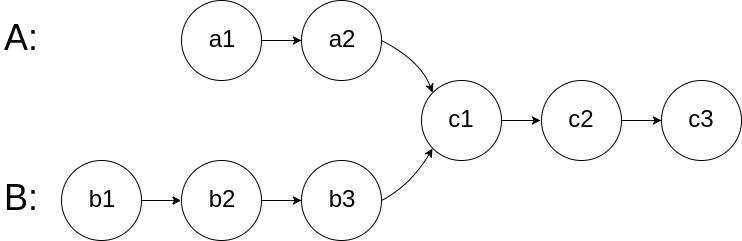
The test cases are generated such that there are no cycles anywhere in the entire linked structure.
Note that the linked lists must retain their original structure after the function returns.
Custom Judge:
The inputs to the judge are given as follows (your program is not given these inputs):
intersectVal- The value of the node where the intersection occurs. This is0if there is no intersected node.listA- The first linked list.listB- The second linked list.skipA- The number of nodes to skip ahead inlistA(starting from the head) to get to the intersected node.skipB- The number of nodes to skip ahead inlistB(starting from the head) to get to the intersected node.
The judge will then create the linked structure based on these inputs and pass the two heads, headA and headB to your program. If you correctly return the intersected node, then your solution will be accepted.
public class Solution {
    public ListNode getIntersectionNode(ListNode headA, ListNode headB) {
        ListNode pA = headA;
        ListNode pB = headB;
        while (pA != pB) {
            pA = pA == null ? headB : pA.next;
            pB = pB == null ? headA : pB.next;
        }
        return pA;
        // Note: In the case lists do not intersect, the pointers for A and B
        // will still line up in the 2nd iteration, just that here won't be
        // a common node down the list and both will reach their respective ends
        // at the same time. So pA will be NULL in that case.
    }
}
1650. Lowest Common Ancestor of a Binary Tree III
Given two nodes of a binary tree p and q, return their lowest common ancestor (LCA).
Each node will have a reference to its parent node. The definition for Node is below:
class Node {
    public int val;
    public Node left;
    public Node right;
    public Node parent;
}
According to the definition of LCA on Wikipedia: "The lowest common ancestor of two nodes p and q in a tree T is the lowest node that has both p and q as descendants (where we allow a node to be a descendant of itself)."
/*
// Definition for a Node.
class Node {
    public int val;
    public Node left;
    public Node right;
    public Node parent;
};
*/
class Solution {
    public Node lowestCommonAncestor(Node p, Node q) {
        Node a = p, b = q;
        while (a != b) {
            a = a == null ? q : a.parent;
            b = b == null ? p : b.parent;
        }
        return a;
    }
}