
LLaVA
LLaVA
LLaVA(Large Language and Vision Assistant)是一个多模态大模型,结合了视觉编码器(Vision Encoder)和大型语言模型(LLM),用于实现图像理解和视觉问答等任务。其核心思想是将图像通过视觉编码器编码为向量表示,然后与文本输入一起送入语言模型进行联合推理。
高分辨率图像:
- 拆分 => Embedding
- 缩放 => Embedding
- LLaVA
- LLaVA-Med
- LLaVA-1.5
- LLaVA-NeXT
- LLaVA-OneVision
Sss
架构
整体架构
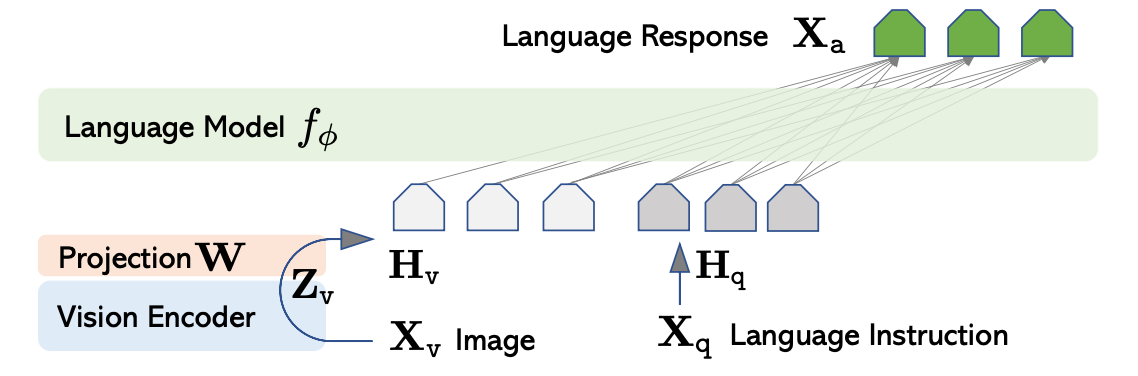
LLaVA 的典型结构包括两个主要模块:
- Vision Encoder(视觉编码器):负责将输入图像编码为特征向量。
- Language Model(语言模型):通常是基于 LLaMA 或其变种的 Decoder-only Transformer,用于理解文本并生成回答。
两者之间通过一个 投影层(Projector) 连接,将视觉特征映射到语言模型的嵌入空间。
模块详解
Vision Encoder
- 默认使用模型:CLIP ViT-L/14(OpenAI 的 CLIP 模型)
- 具体配置:
- 架构:Vision Transformer (ViT)
- 层数(Layers):24
- 隐藏层维度(Hidden size):768
- 注意力头数(Heads):12
- Patch size:14×14
- 输入图像尺寸:336×336(LLaVA-1.5 中将原始 224×224 升级为 336×336 以提升分辨率)
- 参数量:约 304M(0.3B)
- 是否可训练:在 LLaVA-1.5 中,vision encoder 通常被冻结(frozen),不参与微调,仅用作特征提取器。
注:早期 LLaVA-1.0 使用 ViT-L/14 @ 224×224;LLaVA-1.5 升级到 336×336,但 encoder 本身结构未变,只是输入分辨率更高,通过插值调整位置编码。
Projection Layer
- 作用:将 vision encoder 输出的图像 token(如 256 个 patch tokens)映射到 LLM 的词嵌入空间。
- 结构:通常是一个 两层 MLP(Multi-Layer Perceptron)
- 输入维度:768(来自 ViT)
- 输出维度:LLM 的隐藏维度(如 LLaMA-7B 为 4096)
- 中间层维度:常设为 4096 或 768 → 4096 → 4096
- 参数量:约 33M
- 计算:(768 × 4096) + (4096 × 4096) ≈ 3.15M + 16.78M ≈ 20M–35M(取决于具体设计)
- 是否可训练:是,这是 LLaVA 微调时唯一新增且可训练的视觉相关参数。
Language Model
LLaVA 支持多种 LLM 主干,常见配置包括:
| LLM 主干 | 参数量 | 隐藏维度(hidden_size) | 是否可训练 |
|---|---|---|---|
| LLaMA-7B | ~7B | 4096 | 部分或全部微调(通常全参数微调或 LoRA) |
| LLaMA-13B | ~13B | 5120 | 同上 |
| Vicuna-7B/13B | 基于 LLaMA 微调的对话模型 | 同上 | 同上 |
在标准 LLaVA 训练中,整个 LLM 通常是可训练的(尤其在指令微调阶段),但也有研究使用 LoRA 等高效微调方法减少显存消耗。
总参数量
- Vision Encoder(冻结):~0.3B(不计入可训练参数)
- Projection Layer(可训练):~33M
- LLM(Vicuna-7B,可训练):~7B
✅ 可训练参数总量 ≈ 7.03B
✅ 总模型参数(含冻结)≈ 7.33B
| 模块 | 模型 | 参数量 | 是否训练 | 备注 |
|---|---|---|---|---|
| Vision Encoder | CLIP ViT-L/14 | ~304M | ❌ | 输入 336×336 |
| Projector | 2-layer MLP | ~33M | ✅ | 对齐视觉与语言空间 |
| Language Model | Vicuna-7B/13B | 7B/13B | ✅ | 基于 LLaMA |
输入处理流程简述
- 图像 → Resize to 336×336 → 输入 ViT-L/14 → 输出 [1 + 576] tokens(class token + 576 patch tokens,因 336/14=24, 24×24=576)
- 通常丢弃 class token,保留 576 个 patch tokens
- 通过 projection layer 映射为 576 个 LLM 嵌入向量(维度 4096)
- 文本 prompt 被 tokenized,其中
<image>占位符被替换为上述 576 个视觉 token - 拼接后的序列输入 LLM,进行自回归生成
其他变体说明
- LLaVA-NeXT / LLaVA-1.6:引入更强的 vision encoder(如 EVA-CLIP、SigLIP)或更高分辨率(如 672×672),投影层也可能变为更复杂的结构(如 Q-Former、resampler)。
- MiniGPT-4、mPLUG-Owl 等:类似架构,但 projector 设计不同。
如果你关注的是 LLaVA 的某个特定版本(如 LLaVA-NeXT、LLaVA-OneVision 等),也可以进一步说明,我可以提供对应细节。
LLaVA
Visual Instruction Tuning
Visual Instruction Generation
Context type 1: Captions
A group of people standing outside of a black vehicle with various luggage.
Luggage surrounds a vehicle in an underground parking area
People try to fit all of their luggage in an SUV.
The sport utility vehicle is parked in the public garage, being packed for a trip
Some people with luggage near a van that is transporting it.
Context type 2: Boxes
person: [0.681, 0.242, 0.774, 0.694], backpack: [0.384, 0.696, 0.485, 0.914], suitcase: …(omitted)
训练
Stage 1: Pre-training for Feature Alignment.
冻结 Vision Encoder, LLM
训练 MLP
Stage 2: Fine-tuning End-to-End.
冻结 Vision Encoder
训练 MLP
LLaVA-1.5
Improved Baselines with Visual Instruction Tuning
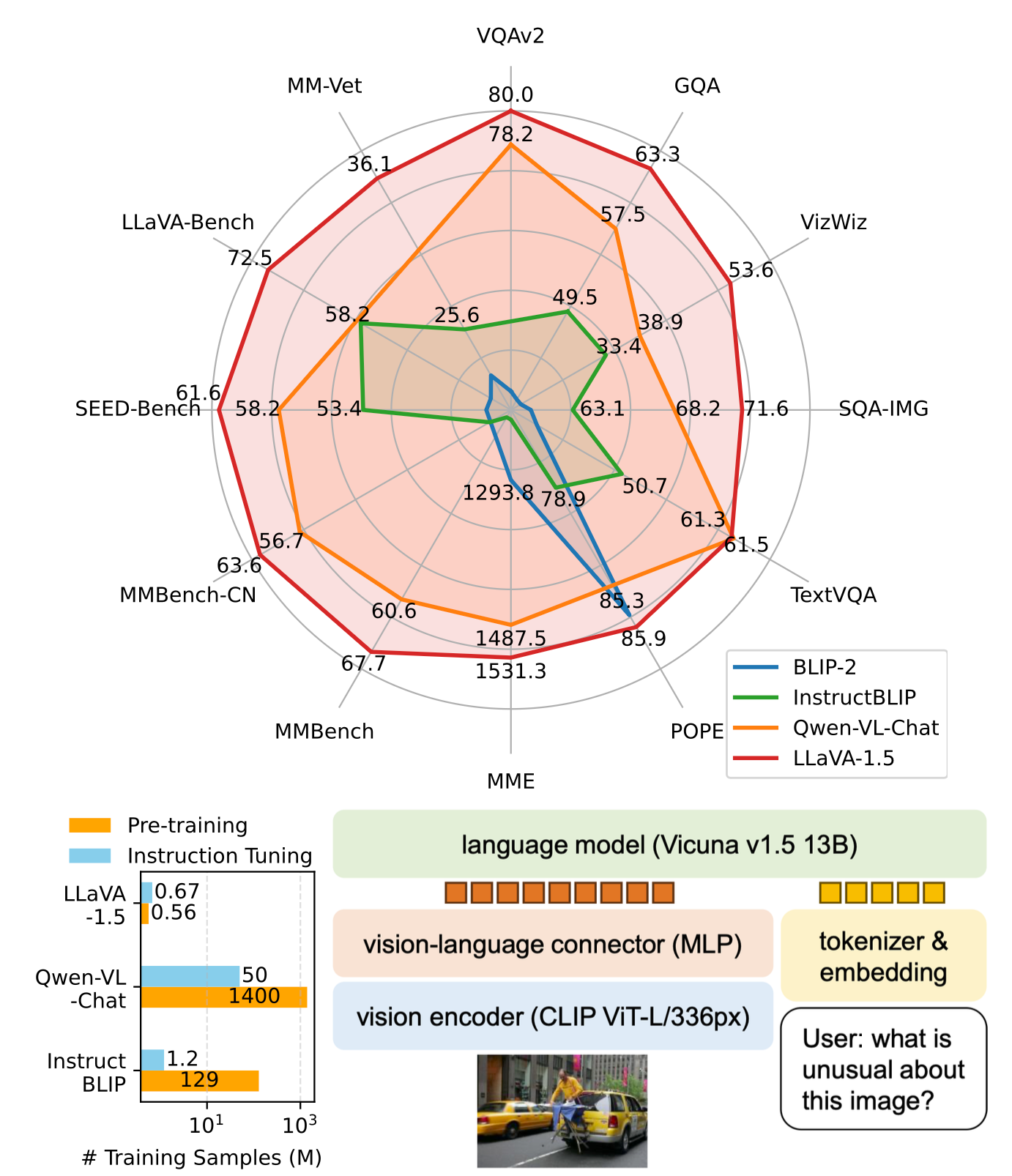
Llava1.5 是llava 的升级 全称 《Improved Baselines with Visual Instruction Tuning》, 是一个多模态视觉-文本大语言模型,可以完成:图像描述、视觉问答、根据图片写代码 (HTML、JS、CSS) , 潜在可以完成单个目标的视觉定位、名画名人等识别 (问答、描述) 。支持单幅图片输入 (可以作为第一个或第二个输入) , 多轮文本对话。
本文基于CLIP的视觉编码器, 以及LLaMa语言解码器, 使用最简单的两层FC构成MLP (Ilava是一层) 映射视觉特征到文本长度,构建了一个大规模的多模态模型, 并且将该模型在指令视觉-语言数据上进行了微调 (数据集更丰富) , 并且通过增加特定指令来解决简单回答指令的跟随性。
亮点
- 用最简单的架构、
- 公共数据集、
- 小的计算资源消耗
- 实现了最佳性能,
- 为未来的研究提供了完全可复制和负担得起的基线
HD
- 分小片
- 缩放完整图
LLaVA-NeXT
LLaVA-NeXT: Improved reasoning, OCR, and world knowledge
- Increasing the input image resolution to 4x more pixels. This allows it to grasp more visual details. It supports three aspect ratios, up to 672x672, 336x1344, 1344x336 resolution.
- Better visual reasoning and OCR capability with an improved visual instruction tuning data mixture.
- Better visual conversation for more scenarios, covering different applications. Better world knowledge and logical reasoning.
- Efficient deployment and inference with SGLang.
LLaVA-NeXT-Interleave
Interleaved
multi-image scenarios
模型接受交错格式输入:[img][text][img][text]...,其中:
img:图像标记,对应图像的视觉特征text:文本标记,对应文本内容
对于视频,每帧图像被视为一个独立的img;对于3D,不同视角的图像被视为多个img。
架构
- 视觉编码器:SigLIP-400M(384×384分辨率)
- 语言模型:Qwen 1.5(0.5B/7B/14B参数)
- 投影层:两层MLP
SFT
- Technique 1: Continue training from single-image models
- Technique 2: Mixed Interleaved data formats during training
- Technique 3: Combining different data scenarios improves individual task performance.
Interleaved Format
LLaVA-OneVision
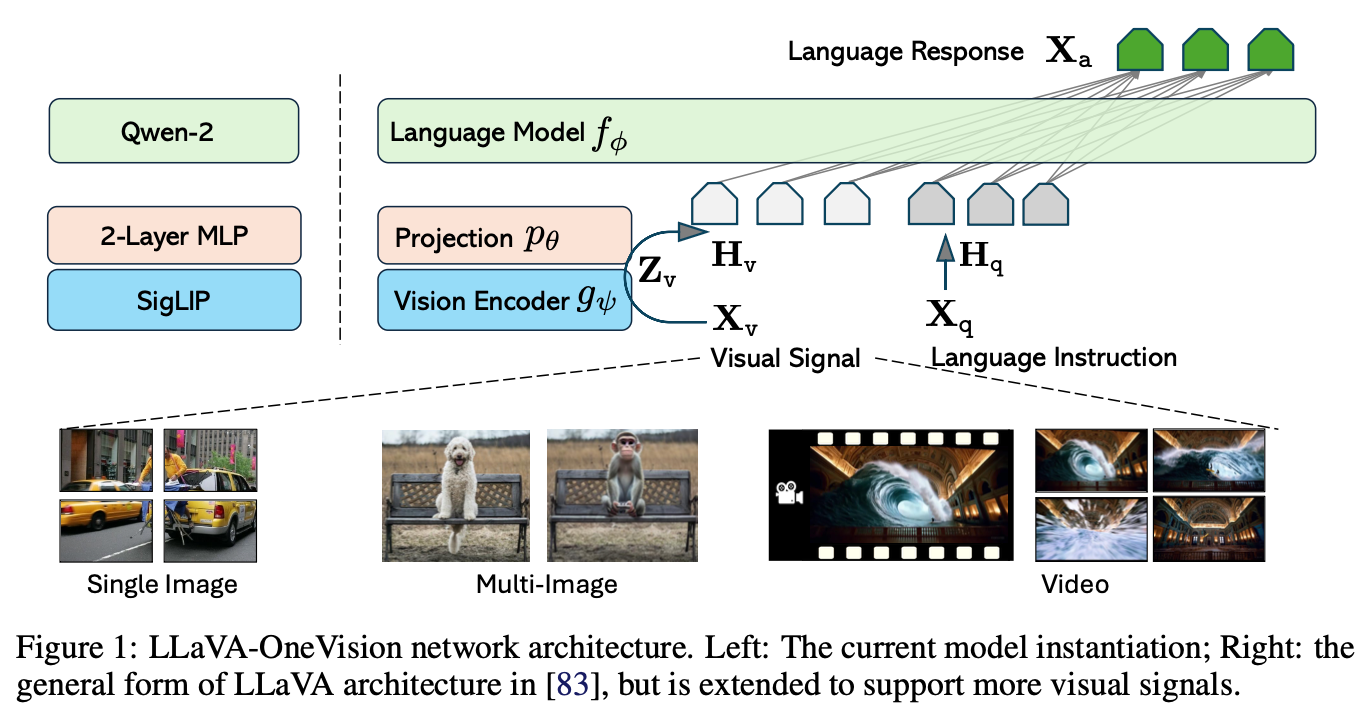
- LLM. We choose Qwen-2 as our LLM fϕ(·) parameterized by ϕ, as it offers various model size and exhibits strong language capabilities to date among publicly available checkpoints.
- Vision Encoder. We consider the SigLIP as the visual encoder gψ(·) parameterized by ψ, encoding an input image Xv into its visual feature Zv = g(Xv). The grid features before and after the last Transformer layer are considered in our experiments.
- Projector. We consider a 2-layer MLP pθ(·) parameterized by θ, to project image features into the word embedding space, yielding a sequence of visual tokens Hv = p(Zv).
AnyRes
Higher AnyRes with Bilinear Interpolation